

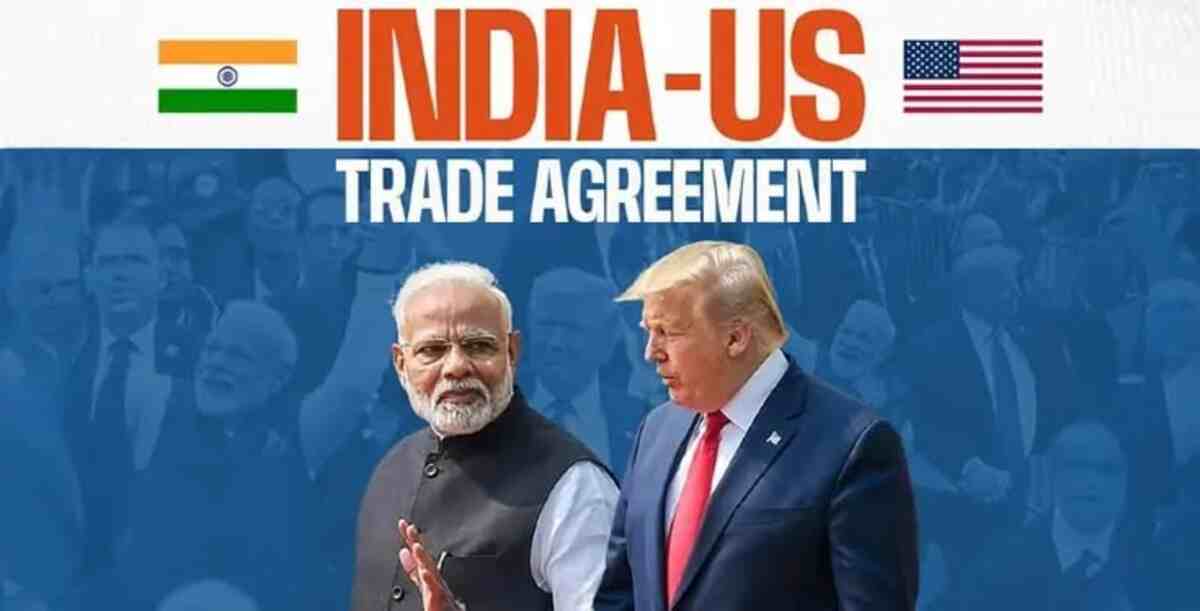
The India-United States interim trade agreement framework announced in early February 2026 has become one of the most discussed global trade developments, reshaping economic diplomacy between two of the world’s largest economies and affecting markets from Asia to North America. This interim framework, pitched as a precursor to a full Bilateral Trade Agreement (BTA), aims to lower barriers, boost market access, and strengthen long-term cooperation across sectors including manufacturing, technology and agriculture.
Under the framework agreed on February 6, India and the U.S. committed to substantial reciprocal tariff adjustments, with the U.S. reducing its applied tariff rate on Indian exports to 18 percent from a previous peak of around 50 percent — a reduction expected to benefit exporters of textiles, leather goods, chemicals and other labour-intensive products. Meanwhile, India signalled it would reduce or eliminate tariffs on a wide range of American industrial and agricultural products, opening its market to foodstuffs, machinery, and other U.S. exports.
Industry and investor sentiment responded positively to the news. Analysts and economic bodies told media that the interim pact framework has boosted confidence in global markets, drawing fresh foreign investment interest and strengthening capital flows into India’s equities and foreign exchange markets. The country’s currency, the Indian rupee, saw renewed support following the announcement, as investors welcomed clearer cooperation and reduced trade friction on a bilateral scale.
However, this interim trade framework has not been without controversy and challenges. Within days of its announcement, the United States Supreme Court struck down parts of the U.S. executive’s tariff authority, triggering debate over how this affects the underlying trade deal structure and tariff policy. Former U.S. President Donald Trump responded by stating that the interim framework would continue to hold India to 18 percent tariffs, even as legal questions swirl over broader tariff mechanisms.
The repeal of certain tariff authorities also prompted political reactions in both countries. In India, opposition parties urged the government to pause or renegotiate the interim agreement in light of the U.S. court decision, arguing that the original commitments may need revisiting to protect domestic interests, especially for sensitive sectors like agriculture and small businesses.
Beyond the bilateral headlines, the trade framework has become part of broader economic diplomacy. At the India AI Impact Summit 2026, the two nations also signed the Pax Silica Declaration, a strategic cooperation initiative focused on building secure technology supply chains in semiconductors, advanced manufacturing and AI-related technologies. This move signals that economic ties are extending beyond tariffs into future-oriented sectors where both countries seek competitive advantage and resilience against global disruptions.
Negotiators from both sides are still finalizing the legal text, with the agreement expected to be signed in March and implemented by April 2026, according to Indian government officials overseeing the talks. Final implementation will open the door for tariff reductions and expand market access, signalling a new era of trade cooperation beyond historical tensions from the previous years’ tariff disputes.
Global economists note that this interim trade framework is more than just a temporary pact — it’s reshaping how major economies manage tariff policy, supply chain resilience, and strategic sector cooperation. As the deal transitions from framework to operational reality, businesses around the world are watching closely to see how new rules on market access, technology exports and reciprocal duties will influence global trade flows and economic partnerships in the coming decade.


